
MAKS Change Sync Service
MAKS Data Synchronisation Micro-service
MAKS Change Sync Service is an integration micro-service that periodically tracks changes in address, building, road, exterior door, interior door, independent unit and related spatial data on MAKS. It pulls changed records, enqueues them, applies them to the target database, and makes the entire process auditable. It runs alongside municipal numbering and GIS systems and is equally suitable for energy distribution companies, infrastructure operators and any sector that depends on current address & spatial data.
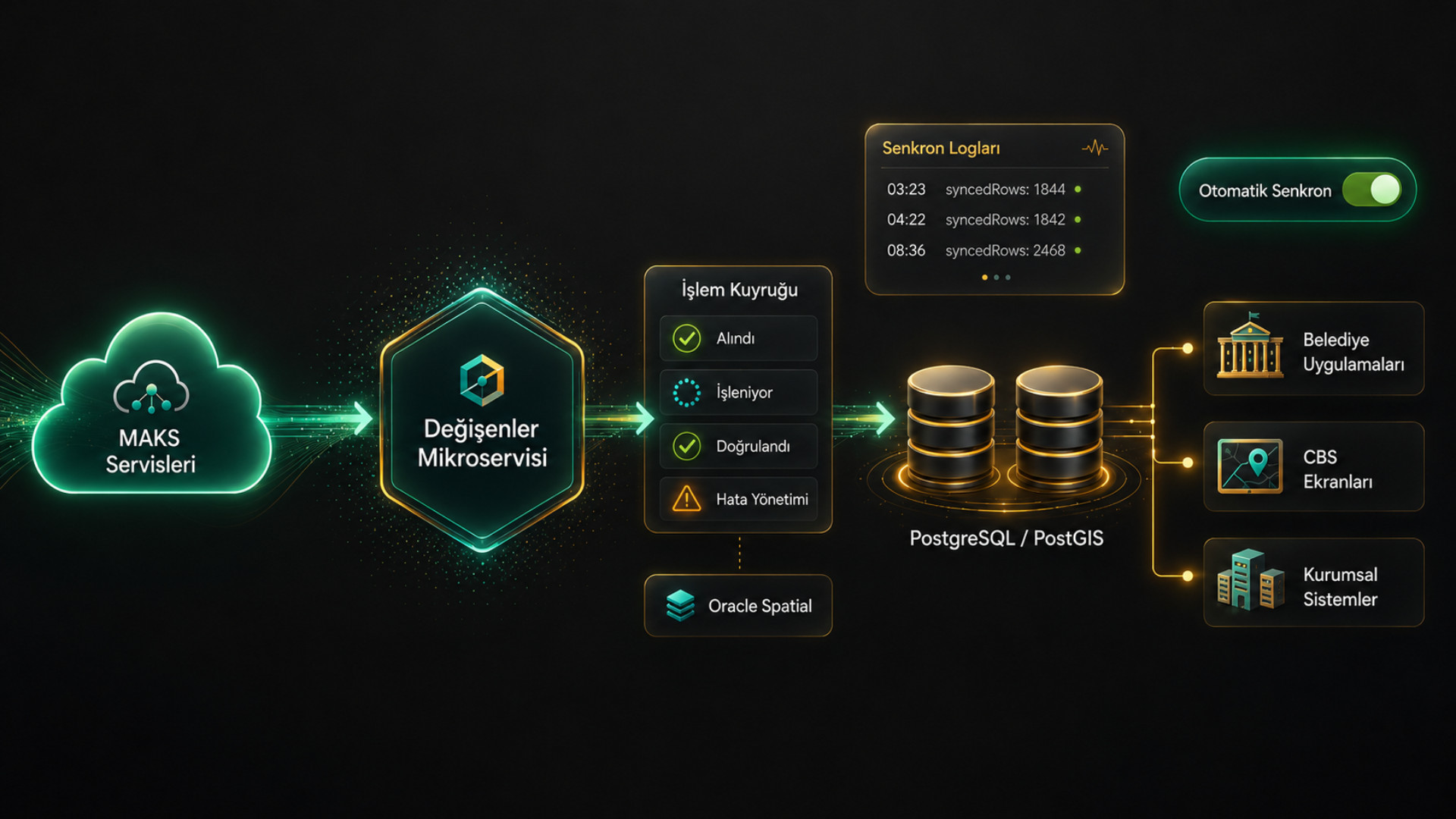
Stay Current Without Manually Tracking MAKS Changes
One of the most important needs in institutional address and spatial-data infrastructure is reliable, regular tracking of MAKS-side changes. MAKS Change Sync automates this — new, updated and deleted records flow into institutional systems under control.
Automatic Change Tracking
MAKS services are polled on schedule; new and changed records are pulled automatically.
Controlled Data Apply
Records aren't pushed blindly — validation and processing steps gate every target-DB write.
Error & Log Management
Successful, failed and pending operations are logged; failed records can be retried and traced.
Sector-Independent Integration
Plug into municipal systems alongside energy distribution and infrastructure GIS/data systems.
MAKS Data Changes the Service Can Track
The service is configurable to track changes across the core address and spatial components of the MAKS data model.
A Micro-service That Plugs Into Your Existing Stack
MAKS Change Sync is designed as a standalone background service. With Docker deployment, scheduled jobs, version tracking, processing queues, error handling and DB adapters it adapts to different infrastructures.
Current Address Data for Municipalities and the Energy Sector
The solution is not limited to municipal MAKS processes — any sector that depends on current address & spatial data can use it. Energy distribution companies in particular rely on fresh building, road, door and unit data for field ops, subscriptions, fault management and planning.
Municipalities
Keeps existing numbering, GIS and city information infrastructures continuously aligned with MAKS data.
Energy Distribution Companies
Provides up-to-date address & building data for subscriptions, connections, field operations and grid planning.
Infrastructure Operators
Lets road, building and address changes flow into infrastructure planning and field operations.
GIS & Data Teams
Raises the freshness of enterprise geospatial data and removes manual update overhead.
Reliable, Traceable and Flexible Integration
Runs Independently from the MAKS / Numbering App
MAKS / Numbering is a full UI application that lets municipalities run address and numbering processes on screen. MAKS Change Sync is a UI-independent integration micro-service that runs in the background. It plugs into existing institutional software, feeds existing GIS and database stacks, and serves data-freshness needs across sectors.
- Has a full user interface
- Manages municipal numbering workflows
- Runs address & numbering operations
- Offers documents, field, map and reporting screens
- Runs as a background micro-service
- Tracks MAKS changes
- Feeds target systems with data
- Plugs into existing applications
- Works beyond municipalities too
What MAKS Change Sync Delivers
Current Data Infrastructure
Changes on the MAKS side flow in continuously, keeping institutional data current.
Less Manual Workload
Update processes are automated; technical teams spend less time on manual ops.
Traceable Integration
Every record carries success, failure and audit history.
Cross-Sector Fit
Adapts to municipal, energy and infrastructure DB/GIS setups.
Other Solutions
NOYAS
GIS-Based Integrated Fire Department Information System
Manage every fire-department process — from incident response and reporting to fleet, training, inspection and digital applications — on a single GIS-based platform.
NOLEVS
Noktasal Sign Management System
A GIS-supported sign management platform that handles street and door-number signs end-to-end: requests, production, stock, field installation, maintenance and reporting.
NOTES
Noktasal Real Estate Inventory System
A modular real estate management solution that lets you manage your institution's property inventory geographically.